
The perio exam is still subjective. This makes it a number.
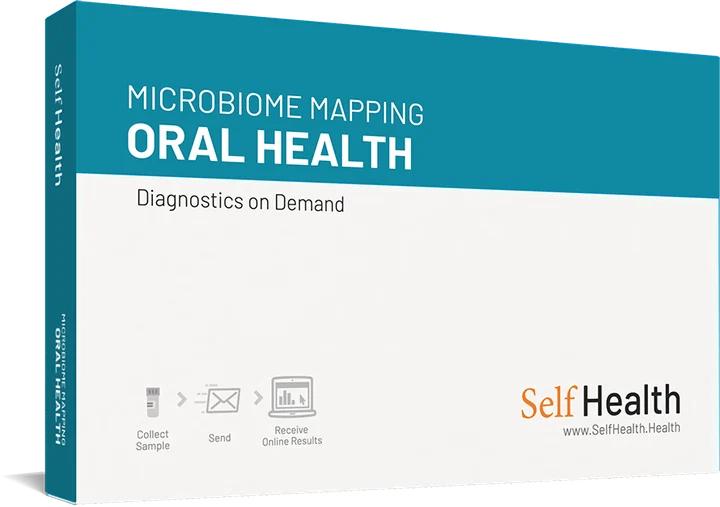
Twelve periodontal pathogens quantified from an oral swab — collected on the hygiene recall you have already booked, and re-tested at the four-to-six week SRP re-evaluation that is already in your workflow.
No draw. No equipment. No added chair time. Buy ten or more and we match the quantity.
You see the patient more reliably than their physician does.
That recurring contact is dentistry’s most underused asset — and the exam inside it is still probing depths, bleeding on probing and clinical judgement.
The highest-frequency scheduled touchpoint in adult healthcare, already on the books and already paid for.
The panel rides on the hygiene visit. Collection is an oral swab — no draw, no equipment, no added chair time.
Scaling and root planing has a booked re-eval. That is a clean pre/post pair no medical clinic can generate as easily.
An objective, quantitative microbial measurement on a visit that is already happening — turning a subjective periodontal exam into a documented, trendable data point you can re-test after therapy. That is the product. Everything else follows from it.
Twenty organisms. One report.
Collected chairside or at home, analysed by a CLIA-certified laboratory, and returned as a patient-facing report with quantitative values against laboratory-defined ranges.
Periodontal pathogens
- Porphyromonas gingivalisRed complex
- Treponema denticolaRed complex
- Tannerella forsythiaRed complex
- A. actinomycetemcomitansLeukotoxin A
- Fusobacterium nucleatumBridging organism
- Prevotella intermediaOrange complex
- Parvimonas micraOrange complex
- Campylobacter rectusOrange complex
- Peptostreptococcus anaerobiusOrange complex
- Capnocytophaga gingivalisGreen complex
- Enterococcus faecalisEndodontic
- Streptococcus mutansCariogenic
Opportunistic, fungal & normal flora
- Staphylococcus aureusOpportunistic
- Pseudomonas aeruginosaOpportunistic
- Acinetobacter speciesOpportunistic
- Haemophilus speciesOpportunistic
- Candida albicansFungal
- Candida speciesFungal
- Streptococcus salivariusNormal flora
- Lactobacillus speciesNormal flora
The published salivary pH span is roughly 6.2–7.6 with a mean near 6.7, so 6.70–7.30 is a AAP Medical flag range and we label it as one. It is not a clinical reference interval.
Reported as quantitative values against laboratory-defined ranges — not as risk stratification. No analyte on this panel has a published clinical cut-point tied to a systemic outcome. Periodontal disease remains a clinical and radiographic diagnosis. Performed by a CLIA-certified laboratory; not cleared or approved by the FDA.
Low abundance is not low significance.
Three organisms carry most of the periodontal literature, and the panel quantifies all three.
Porphyromonas gingivalis
Keystone pathogenEven at low abundance it remodels a commensal community into a dysbiotic, inflammatory one through complement manipulation. A low count does not mean a low-significance finding.
Hajishengallis, Nat Rev Immunol 2015
Treponema denticola
Motile spirocheteIts dentilisin protease degrades periodontal ligament matrix and activates host matrix metalloproteinases; it contributes to alveolar bone loss in animal models.
Socransky, J Clin Periodontol 1998 · PMID 9495612
A. actinomycetemcomitans
Leukotoxin AInduces the neutrophil hypercitrullination that mirrors the rheumatoid joint, and exposure correlates with ACPA and rheumatoid factor in RA patients. A hypothesis, not a proven cause.
Konig, Sci Transl Med 2016 · PMID 27974664
Absence of pathogens indicates health; presence does not indicate disease. A clean panel is meaningful reassurance and supports a longer recall interval. An abnormal panel is a prompt for clinical correlation — not a diagnosis.
Say the limitation first.
We would rather state the boundary than have your periodontist find it. Everything below is checked against the primary literature.
What it is
- A quantitative oral microbiology panel. Twelve periodontal pathogens plus opportunistic organisms, Candida, normal flora and salivary pH.
- An objective number for a subjective exam. Documented, repeatable, trendable, and re-tested after therapy.
- Association-level context. Periodontitis is independently associated with atherosclerotic cardiovascular disease after adjusting for shared risk factors. AHA Scientific Statement, Circulation 2012 · PMID 22514251.
What it is not
- Not a cardiovascular, RA or dementia test. Causation is not established, and no periodontal therapy has been shown to change cardiovascular outcomes.
- Not a screening test. Screening implies established sensitivity, specificity and outcome benefit. None exists here for any systemic endpoint.
- Not a diagnosis. Periodontal disease remains a clinical and radiographic diagnosis. This informs it; it does not replace it.
The Alzheimer’s link — the gingipain-inhibitor trial randomised 643 patients, missed both co-primary endpoints and the programme was discontinued. “Low Lactobacillus signals lost protection” — inverted; in dentistry elevated counts are the classical caries correlate. And “directly linking gum health to heart disease” — the AHA statement exists specifically to rebut that framing. If a vendor still has those on a slide, ask them why.
Test. Treat. Re-test.
Dentistry is the only setting where this loop closes cleanly, because the follow-up appointment is already in the workflow.
Baseline at diagnosis
The panel is collected at the recall or perio exam already booked. Quantitative starting point, patient-facing report.
Rides on D1110 / D4910Therapy
Scaling and root planing delivered in-house within weeks. Nothing about your clinical protocol changes.
D4341 / D4342Re-test at re-evaluation
The 4–6 week re-eval is already scheduled. A second panel documents microbial response and justifies the maintenance interval.
Collection D0417 · analysis D0418A patient who sees a number move is a patient who comes back. The re-test converts perio maintenance from a recommendation into a documented result — and gives the hygienist something objective to show at the next recall.
You buy it. You price it. You keep the difference.
You buy at clinic pricing and resell at your own price, and we match any stock comes back to us at our cost.
| Attach rate on hygiene visits | Panels / month | You keep each | Monthly | Annual |
|---|---|---|---|---|
| 5% of 250 hygiene visits | 13 | $45 | $585 | $7,020 |
| 10% of 250 hygiene visits | 25 | $45 | $1,125 | $13,500 |
| 20% of 250 hygiene visits | 50 | $45 | $2,250 | $27,000 |
Modelled on 250 hygiene visits a month — populate it with your own recall volume. Every column above is margin, not revenue, and nothing is Stack a General Wellness ($130 margin) or a PGX ($75) and the blend rises sharply.
Start with oral. Stack the rest.
The same patients buy the rest of the catalogue, and every panel ships on the same terms. Adding one adds a revenue line without adding capital, space or chair time.
Oral is the swab
No draw, no phlebotomy chair, no centrifuge. The one panel purpose-built for a dental operatory.
Pharmacogenetics fits dentistry
Codeine and tramadol metabolism via CYP2D6 is a CPIC Level A pair — and it is prescribed from your chair.
The rest ride along
Patients already ask. Six of the eight panels need no draw at all and can go home in a bag.
Four questions decide whether this works in a dental practice.
Here are our answers — including the two we need from you.
Who orders and interprets?
You order it for periodontal management, which is squarely in scope. Systemic findings trigger a referral to a physician — never an interpretation from the dental chair. We build that protocol into the report.
Where does the laboratory work sit?
Specimens go to our CLIA-certified partner laboratory. If any part were run in your office you would need your own CLIA certificate, so we keep all of it off-site.
How is it coded?
Collection is CDT D0417 and laboratory analysis D0418; wellness or educational use falls to D9999. It attaches to the recall visit you have already booked.
How is it billed?
Direct to the patient, cash-pay. We do not recommend pass-through billing at a markup — several states restrict it and it creates exposure your practice does not need.
Two things we verify with you at contracting: your state’s scope-of-practice position on ordering laboratory tests, and your preferred billing route. Both are practice-specific and neither is our call to make. Coding, scope and billing rules vary by state — confirm with your own advisors before you launch.
What your periodontist will ask
Two of these answers cost us something. They are here anyway.
Is this qPCR or culture?
We confirm the method in writing with the performing laboratory before you order. Commercial oral pathogen panels are almost universally qPCR, which measures genome equivalents — including DNA from dead organisms — rather than colony-forming units. If yours is qPCR, the report says genome equivalents/mL and we will not let it say CFU/mL. An oral microbiologist will catch the difference, and they should.
Does this change what I actually do?
Not your protocol. Scaling and root planing is still scaling and root planing. What changes is that the diagnosis is documented with a number, the maintenance interval is justified with one, and the patient can see the difference between the two panels.
Can I tell patients this screens for heart disease?
No, and we will not print material that implies it. Periodontitis is associated with atherosclerotic cardiovascular disease; the AHA scientific statement that establishes the association explicitly rejects causation, and it was written to rebut industry claims of exactly that shape.
What about the Alzheimer’s connection?
It was tested and it failed. The GAIN trial randomised 643 patients to a gingipain inhibitor and missed both co-primary endpoints; the FDA placed a clinical hold for hepatotoxicity in January 2022 and the sponsor discontinued the programme that August. We cut the claim from our own material rather than defend it.
Who handles an abnormal systemic finding?
The performing laboratory holds the result-delivery and escalation obligation. From your chair, a systemic finding is a referral to a physician. That boundary is printed in the report so it is not left to the hygienist in the moment.
How much hygienist time does it add?
The swab itself is under a minute. Explanation, consent, packaging and dispatch are the real cost — budget the same 25 to 40 minutes per panel we quote every practice until you have your own number, and treat the first quarter as the measurement.
One panel. One quarter.
Start on the oral panel alone, attached to hygiene recall. Prove the attach rate and the re-test conversion, then stack the rest.
Register and stock
Provider registration and verification, then your opening order ships. No purchase order, no capital, no minimum.
Verification in 24hTrain the hygienists
One virtual session: the offer, consent, swab collection, dispatch and how to read the report back to the patient.
One sessionRun and measure
Attach rate on recall, re-test conversion at the SRP re-evaluation, and staff-minutes per panel.
Your numbersAt 250 hygiene visits a month and $45 margin per panel, on clinic pricing. Illustrative, and not a guarantee of results.
What arrives
- Your opening order — plus the matched stock on 10+
- One virtual hygienist training session
- Provider portal access for results
- CLIA certificate number and named assay method
- A free listing in the patient directory
The same programme runs for men’s health, wellness and vascular practices with a different lead panel. Start at the partner page and we will pick one from your patient mix.